Part 1: The Perimeter Has Moved to the Browser Tab
Traditional enterprise data loss prevention (DLP) was engineered for a business environment where sensitive information left an organization through predictable, well-monitored egress points: unencrypted outbound emails, corporate file storage links, or physical USB storage devices. That perimeter no longer exists.
Today, over 80% of enterprise organizations grapple with unsanctioned or unmonitored shadow AI adoption across their workforce. When a software engineer pastes raw database configuration code into an external web LLM, or a corporate legal advisor drags an unredacted commercial contract into a cloud summarizer, traditional network proxies and API firewalls are effectively blind. They observe standard encrypted outbound HTTPS traffic. By the time a cloud CASB or network gateway flags an egress pattern, the sensitive prompt has already reached external cloud infrastructure.
The primary vector for AI-era corporate data exposure is rarely a complex zero-day exploit. It is a trusted team member moving quickly inside a web browser tab. The Intercept Reality: Network DLP vs. Point-of-Origin Defense
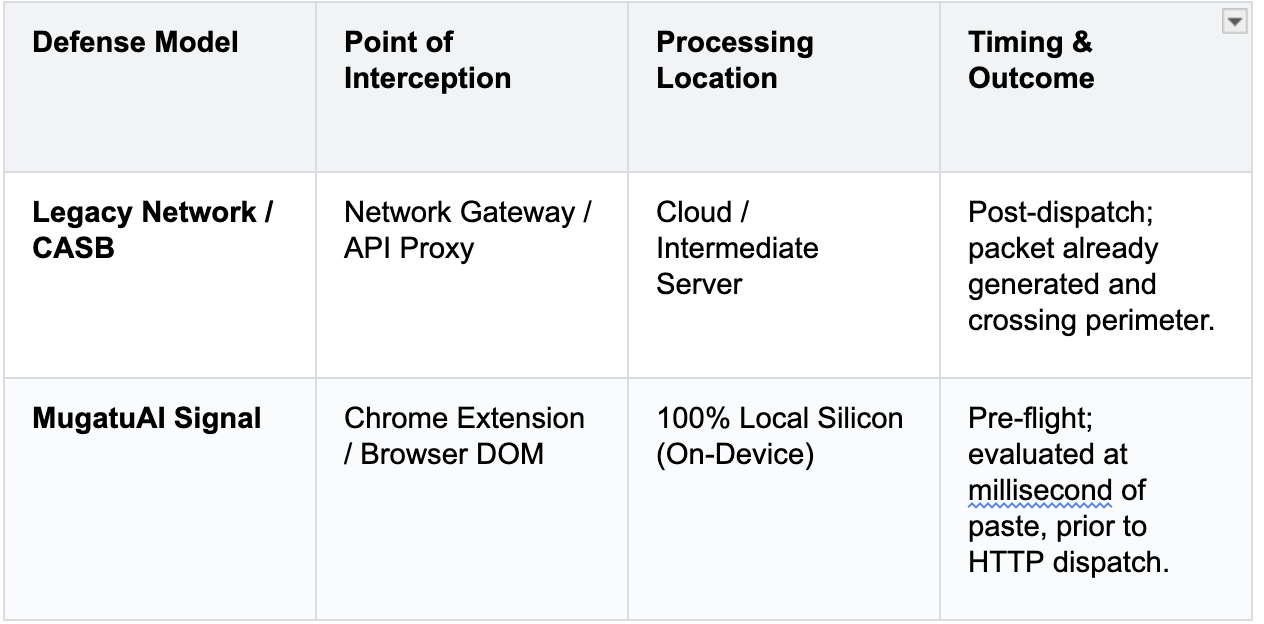
Establishing the First Line of Defense Mitigating real-world generative AI risk requires shifting the point of inspection upstream to the exact point of entry: the web browser.
Operating as a native Google Chrome extension, MugatuAI Signal serves as an immediate, endpoint-first defensive line. By intercepting keystrokes, clipboard paste events, and drag-and-drop file actions directly inside the DOM, Signal inspects and masks sensitive outbound tokens before an HTTP request is dispatched. Pre-Flight Interception: Prompts are evaluated at t = 0, before the user submits the form or presses Enter.
100% Local Silicon Execution: No cleartext prompts or logs leave the local machine to third-party servers for evaluation. Frictionless In-Line Protection: Protection operates natively in Chrome tabs, where modern employees conduct daily knowledge work.